Your words are becoming a design engine.
Max asked Claude, an AI, to learn how you look at design — from the calls, your documents, and the interview you did in July. This page is the workshop with the doors open: every site below was generated by that engine, and every rule it follows is tagged with where it came from — your words, or our own call still waiting for your correction.
Everything below is real and opens full-screen. And there are four questions for you at the end — ten minutes, a voice note per answer is perfect.
Exhibit A
The same garage, twice.
One fictional test client: Garage Rafid, an independent car garage near Antwerp. The engine built its website twice from the identical brief — once before it read your interview, once after. The brief held still; the engine changed in between — your interview, plus lessons from round 1’s own failures. The difference between the two is that learning, made visible.
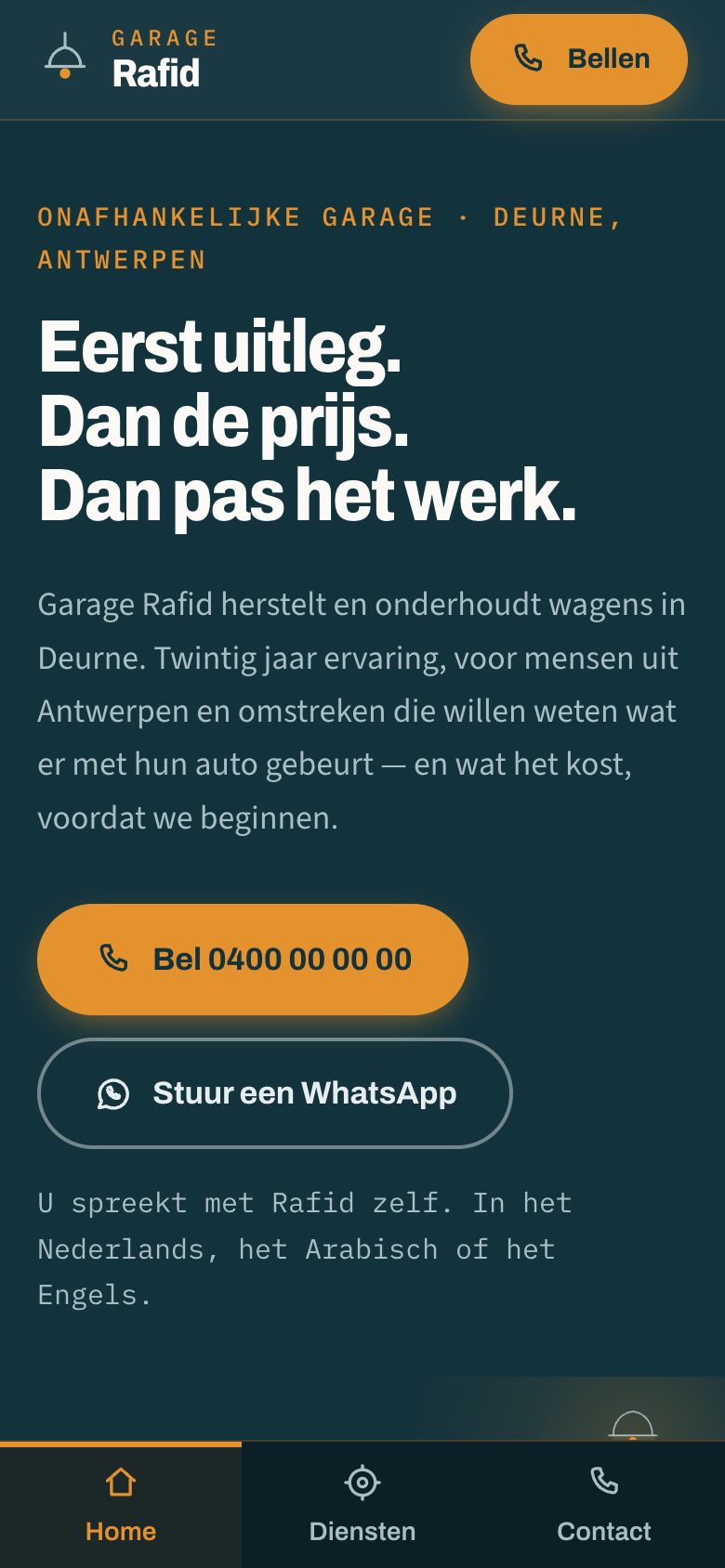
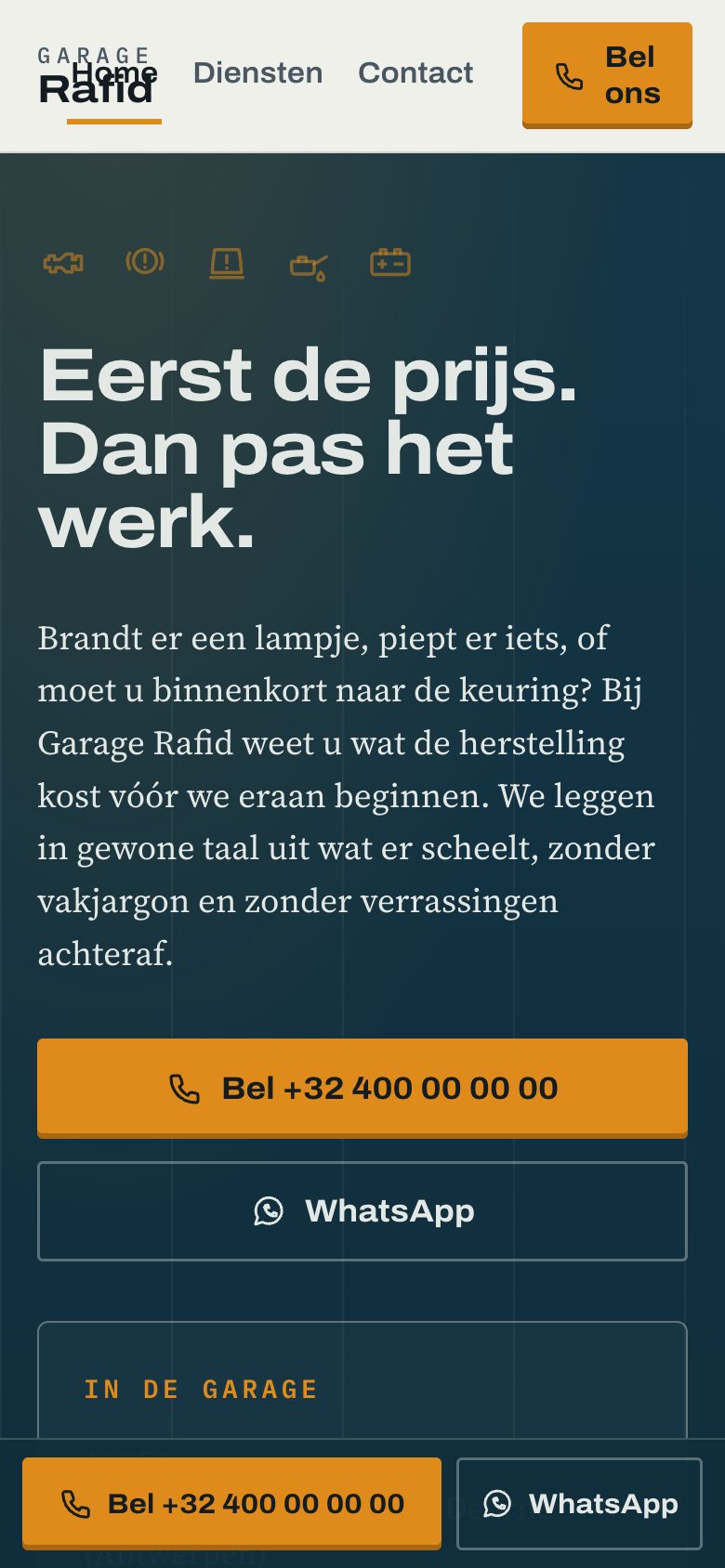
Which one would you ship to Rafid — and why? Your gut pick plus the reason. The labels tell you which is newer — ignore them if you can; “the old one, because…” is a perfectly good answer. The why matters more than the pick: that single sentence trains version 3.
Answer on WhatsAppOpen the hood on take 2 — the full brief, the exact instruction, and the build conditions →
The machine room
How this works — the whole loop.
- 01You talk.
Calls, WhatsApp messages, the big July interview. No forms, no jargon. Your words are the raw material — nothing else is.
- 02Claude mines it.
Every design conviction you voice becomes one line in a taste ledger, with your quote attached and an honesty tag: did you actually say it, or is it still our guess? The guesses are the shopping list for the next conversation.
- 03The ledger compiles into the skill.
One instruction file the engine reads before every job. It is a real, working document — you can read the rules it follows.
- 04The engine builds blind.
The engine — that’s Claude running the skill — gets one client brief and nothing else. No design input from Max, none from anyone. Out comes a complete site: pages, copy, code — built twice per brief sometimes, to see how much is skill and how much is chance. See one build opened up.
- 05You react, it learns.
Your reactions go back into the ledger; the ledger recompiles into the next skill version. This page already shows one full lap — and it keeps working like this: every future call, message or correction from you or Max feeds straight in.
The wall
Every site the engine has built.
Three invented test clients, chosen to stretch different muscles: a Flemish garage, a Flemish tavern, a Spanish gardener. Every address and phone number on them is fictional — the call buttons lead nowhere on purpose — and they’re shown exactly as the engine delivered them, flaws included. Open them full-screen, on your phone too: mobile is one of the things your interview changed.
Where it started
no skill · julyRound 1 — before your interview
skill v1 · 3 augGarage Rafid — take A
NLA self-drawing car under a workshop lamp; a classic services grid. “Eerst uitleg. Dan de prijs. Dan pas het werk.”
open ↗Garage Rafid — take B
NLThe same brief, run a second time — this one invented a paper work-slip. No two runs come out the same; that gap is data too.
open ↗Taverne De Smidse
NLA tavern in an old smithy: the forge tagline, two zones of light and dark.
open ↗Jardinería El Roble
ESThe one that escaped round 1’s house habit of going dark.
open ↗Round 2 — after your interview
skill v2 · 3 augGarage Rafid — take A
NLA dashboard ignition self-test, then stillness. Services become symptom → repair translation rows; a tear-off work order.
open ↗Garage Rafid — take B
NLA painted line on the workshop floor walks you to the phone number.
open ↗Taverne De Smidse
NLThis week’s menu on a real slate chalkboard — the missing prices live exactly where a board is supposed to be rewritten.
open ↗Jardinería El Roble
ES“Su jardín sigue vivo mientras usted no está.” Its signature: a twelve-month calendar that knows what month it is. It also speaks as its owner; that’s question 3 below.
open ↗The ledger
The engine so far.
No skill at all. The tracer site you judged in July. It earned its place on the wall by being the baseline.
Compiled before reading your interview — on purpose. Built from what existed until then (the two calls, your documents, our notes), every guess tagged as a guess, so your answers would show up as a measurable difference instead of vanishing into a rewrite.
Compiled after Claude read the full interview transcript — all 9,834 words of it. Five of v1’s working assumptions didn’t survive your answers. The garage pair at the top of this page is the before/after of exactly that.
Waiting on you. It compiles from your reactions to round 2 — the questions below are its raw material.
Read the skill itself — the actual file, plus what each version changed and why →
Over to you
Four questions — whenever you have a minute.
Tap a question for ten seconds of context, then answer on WhatsApp in whatever form you like — a voice note is perfect. Each answer feeds version 3 directly.
Q1Which garage would you ship — and why?the pair
The two takes at the top of this page: same brief, same fictional client, built before and after your interview. Pick the one you would actually hand to Rafid, and say what decided it — however it comes out.
Answer on WhatsAppQ2Walk any site — what would you correct first?your list
Open any site on the wall, and if a list of small corrections starts forming, this is the place for it — a colour, a word, a spacing, anything. Nothing is too small; the engine learns most from exactly those corrections.
Start the list on WhatsAppQ3May a site speak as its owner?policy call
El Roble writes in the first person — “Soy Andrés Molina” — the site talks as the man himself. Both garage runs refused to do that, reasoning it would put words in the owner’s mouth. Same rulebook, opposite calls: the rulebook is missing your line.
On the table: first person allowed when it fits the client, but every claim it makes about the business gets the owner’s sign-off before launch. Yes, no, or your own version?
Answer on WhatsAppQ4The curation protocol — yes, no, or adjust?three lines
How you and the engine would actually work together on real clients, in three lines:
1 · the engine generates a few directions, freely
2 · you react to finished work — never to specs or mock-up promises
3 · refinement loops on your specific corrections, until you’d ship it
If that matches how you curate, a simple yes is enough. If it doesn’t, say where it bends.
Answer on WhatsApp